COPAHAGEN HAS THE EMPEROR'S NEW CLOTHES
I have shown restraint for five years while quietly judging everyone responsible for Copenhagen fashion's meteoric rise. But I’ve had enough. What I am about to share might lead to my crucifixion, but Jesus Christ and I have much in common, especially regarding spreading the gospel (according to us).
You’ve probably seen the slow motion videos of Copenhagen's “street style” on social media. I blocked or hit the “not interested” button as if my life depended on it. But despite my extreme efforts to avoid these videos, Instagram and TikTok continued to force-feed me the horror.
Words failed me at every attempt to articulate why the fashion choices of the Danish people feel especially sinister. The final straw was a 12-second video I saw on TikTok. There is no special reason for why this video riled me up enough to force me to finally articulate the soullessness of popular Copenhagen fashions because the app has shown me worse. I’ve spent months keeping my thoughts to myself because I couldn’t articulate what differentiates what I am about to show you from what you will find on Instagram accounts like “Watching New York.” And because CPH is currently one of fashion’s darlings, I didn’t want to dilute my serious criticisms by rushing to be the first hater.
Here are stills from the video, illustrating my point:
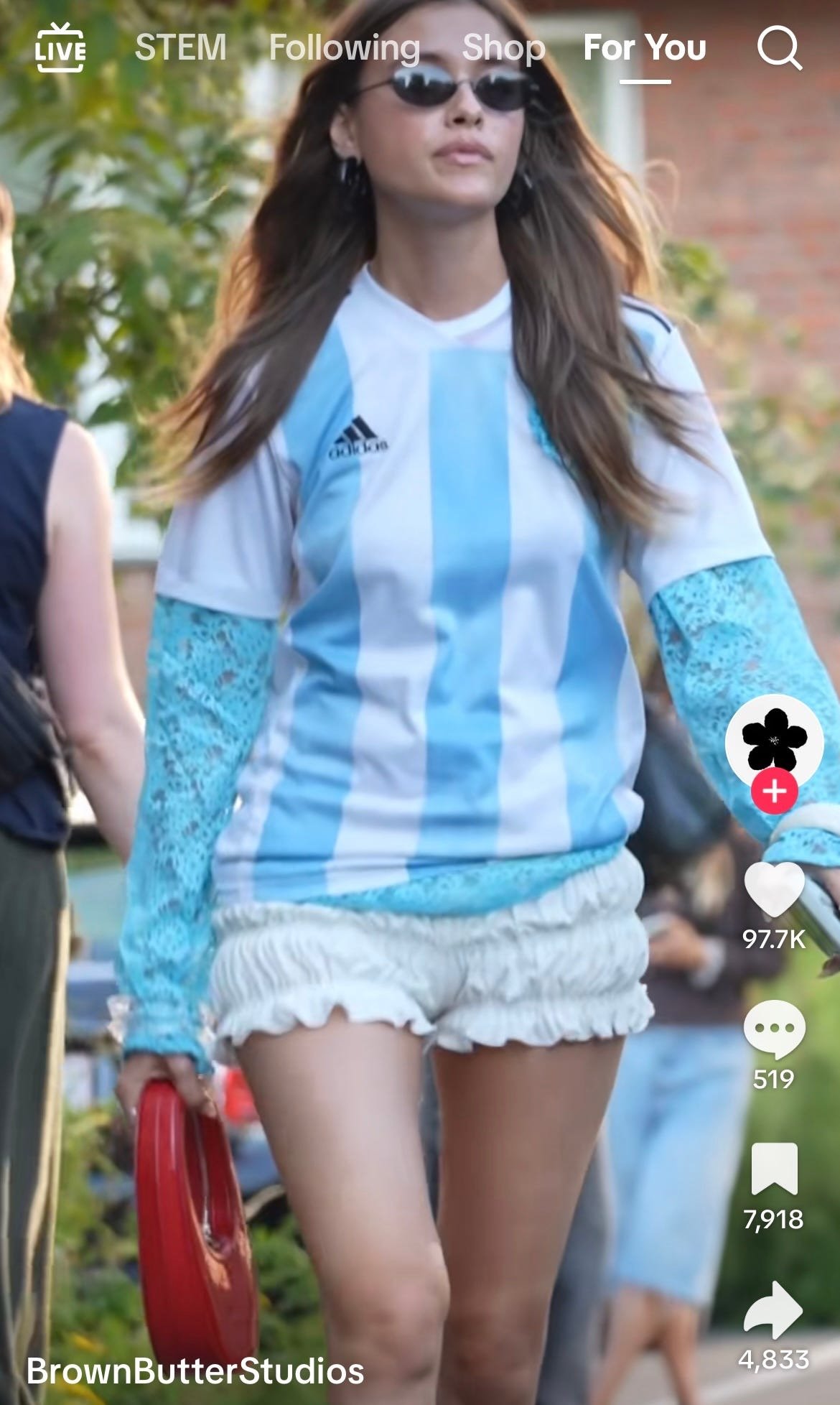
The first outfit that unclogged the block that was preventing me from articulating the diabolical nature of Copenhagen street style is this ensemble that genuinely confuddles me. This person has taken the most uninteresting aspects of every trend: lace, sporty, and bloomers (if you can call those bottoms that) to create something of nightmares. If you told me it was generated by AI, I wouldn’t question it because this ensemble looks like the wearer asked ChatGPT to incorporate every trend that exists and it spat this out.
There is a sterilized aspect to these ensembles that frightens me. A trained eye can see there is no context for the outfit except that the wearer thinks it makes them look cool. And while that is a good enough reason to like something, it’s dangerous for building a functional wardrobe because you might end up with incongruent “cool” garments. The wearer has stripped everything that would make these items delightful separately by combining everything to make this sinister ensemble.
And I am not making claims that these people don’t know themselves. I’m saying you needn’t be a “fashionista” or a fashion lover to genuinely appreciated the time it took to dream up and make a single garment. Because you would never choose these individual pieces to begin with. They look cheap, poorly tailored and unimaginative. The ensemble has no soul.

These people dress like they recently learned about clothes. One would think they recently found out about fashion as a concept, so they grabbed everything that sparkled. I now understand why Jesus wept. I am in shambles.
Can someone explain why people think this is an interesting point of view? One of my favorite emerging designers is from Copenhagen, but I worry that the “fashion crowd’s” relationship to clothes has the same stench as District 1 in Hunger Games. It wreaks of GLUTTONY! EXCESS! If you can't decide what to choose, choose everything in the worst quality!
I do not mean to be condescending when I ask why anyone would own any of these items in the first place. I am speaking from my experience and knowledge as a stylist that most people’s wardrobes are fleeting. They want the clothes to make them more interesting than they are, which is too much pressure for a single piece of fabric. She’s (the fabric) is nervous!
Because of my trained eye, I can tell you that there are certain wardrobe choices people make that reveal their relationship to clothes. I know if you love your clothes because I have interacted with people who love their clothes. But loving your clothes doesn’t automatically translate to knowing how to wear them, which is why I’m not saying that people who love their clothes dress better. Loving your clothes might force you to appreciate the garment as it is, instead of hoping it will be more than it is. Through this acceptance, you might begin to formulate a relationship to your clothes that might help you dress better. For example, before manipulating your button down shirts into skirts, accepting your shirt for its designated function first might help you devise new ways to wear it.